This PredActor behavioral reaction demo could not be loaded.
01 / External interaction
Behavior under physical interference.
This hardware sequence shows the policy following walk and stand commands while responding to external interference.
Academic Paper · cs.RO
PredActor predicts future states for guidance and generates actions for direct execution, using only proprioceptive observations and optional task context.
Real robot footage · 0.5x / 1.0x
Predictive action control
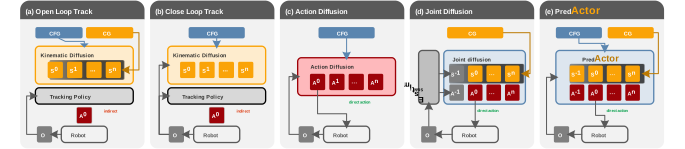
Humanoid policies must follow task commands while adapting to physical feedback. Motion-reference generators rely on separate trackers for execution. Action-only diffusion generates actions directly, without an explicit future-state trajectory for look-ahead guidance. Joint state–action diffusion provides this predictive representation.
PredActor builds on the joint formulation to combine two steering interfaces: classifier guidance (CG) applies test-time objectives to predicted states, while classifier-free guidance (CFG) strengthens learned task conditions. Future states stay internal; selected joint actions execute directly, without a separate motion-reference tracker.
The generator cannot revise behavior from robot feedback, and its references still depend on a separate tracker for physical execution.
Feedback can shape later plans, but kinematic generation remains separated from dynamics-level reaction, timing, and recovery.
Direct action prediction removes the tracking handoff but provides no future-state trajectory for look-ahead objectives.
Internal future states enable predictive guidance. PredActor combines CG and CFG within this formulation, conditioned on proprioceptive history.
Paper figure · control forms
On narrow screens, scroll horizontally to inspect the figure labels.
Method overview
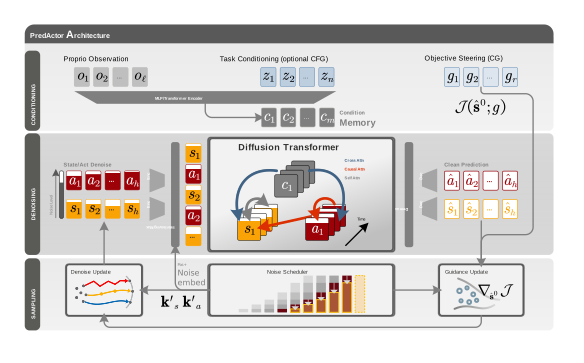
PredActor jointly denoises future states and actions from proprioceptive history and optional task context. Predicted states support CG; conditional and null predictions support CFG. No externally estimated full-body state is required as a policy input.
Paper figure · architecture
On narrow screens, scroll horizontally to inspect the SVG labels.
Paper figure · training
On narrow screens, scroll horizontally to inspect the SVG labels.
Paper figure · deployment
On narrow screens, scroll horizontally to inspect the SVG labels.
Only proprioceptive observations are needed. CG guides internal predicted states; CFG strengthens learned task conditions, with direct action execution.
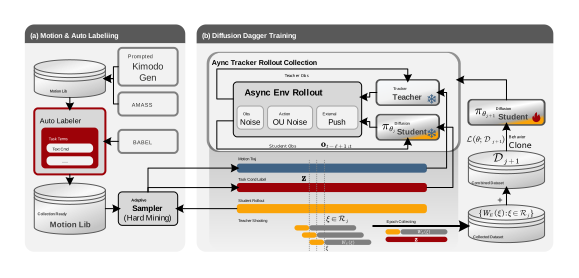
Automatic task labels, asynchronous perturbed teacher rollouts, and learner-state aggregation support the training pipeline.
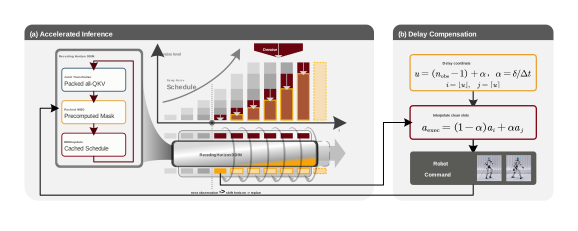
Rolling denoising, computation-preserving optimizations, and delay compensation enable deployment on a Unitree G1 with Jetson Orin NX.
An editable interface brings text commands, semantic interpolation, and whole-body steering to the same denoising core; the open-source implementation spans training through deployment.
Steering and onboard execution
In simulation, PredActor reaches all 15 destination targets and achieves 0.580 text retrieval versus 0.373 for conditional action diffusion, with similar observed push survival (0.535 versus 0.564).
In an offline, zero-actuation Jetson Orin NX benchmark, the complete callback takes 16.790 ms median and 19.383 ms p95; 593 of 600 measured callbacks meet the 20 ms period. This supports measured 50 Hz feasibility, not a hard-real-time guarantee. To our knowledge, PredActor is the first joint state–action diffusion policy deployed entirely on a Unitree G1's onboard Jetson Orin NX for 50 Hz control.
Qualitative control evidence
Across simulation and physical G1 evaluation, PredActor demonstrates text-conditioned motion, joystick steering, disturbance response, and behavior transitions. Two simulation sequences and three hardware demonstrations are followed by a paired simulation sweep of semantic targets at matched blend weights.
This PredActor behavioral reaction demo could not be loaded.
This hardware sequence shows the policy following walk and stand commands while responding to external interference.
This PredActor walk, squat, and walk demo could not be loaded.
The commanded sequence transitions from locomotion into a squat and back to walking, with each text instruction shown alongside the hardware response.
This PredActor walk, jog, and squat demo could not be loaded.
A second commanded sequence changes locomotion speed before transitioning into a squat, preserving the text-to-behavior progression in one continuous view.
This comprehensive PredActor MuJoCo demo could not be loaded.
This MuJoCo sequence combines text commands and joystick steering, response to external interference, and continuous interpolation between behavior targets.
This PredActor joystick steering demo could not be loaded.
The simulation shows joystick-directed turns while text commands switch the locomotion mode between walking and running.
Parallel behavior sweep
Each column uses the same blend weight for both rows, showing the conditioning transition from standing to a gesture and from standing to locomotion.
Authors and resources
Anonymous Institution