AttnWalk: Attention-Enhanced Reinforcement Learning With Reward-Predicted Curriculum for Wheel-Legged Robots

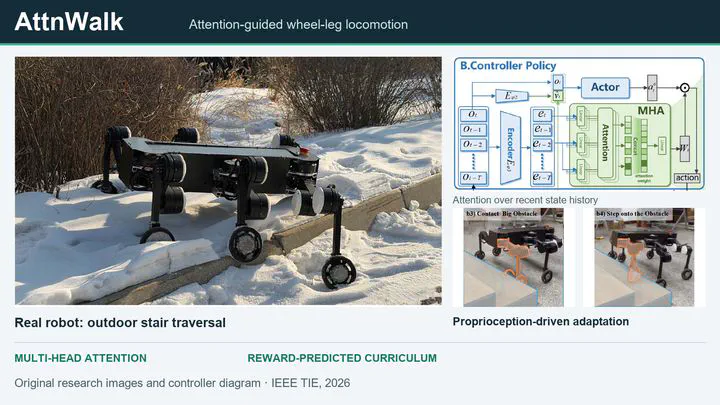 Composed from Figs. 1, 2 and 8 of the AttnWalk paper (Zhang et al., IEEE TIE, 2026). Original research images and method diagram.
Learning terrain changes from contact and motion
Without a terrain camera or elevation map at deployment, the controller must infer changing terrain from its own motion and contact history. AttnWalk attends to informative historical states and adjusts wheel and leg commands, favoring rolling on flat ground and stepping when higher obstacles are encountered.
Attention and curriculum
The policy uses the current observation as a query over recent proprioceptive history. Its attention and action-modulation weights provide a view of which past events influence wheel-leg coordination. A reward-prediction curriculum jointly samples velocity commands and terrain difficulty, reducing training on infeasible combinations while retaining learnable challenges.
The paper evaluates the approach in simulation and on a real hexapod wheel-legged robot, including snow, grass, steps, paved surfaces, and cobblestones. Reported hardware results include 2.5 m/s flat-ground speed and continuous traversal of 13 cm steps. These results concern the tested platform and settings; the method uses proprioceptive feedback rather than explicit look-ahead terrain perception.
Publication status: IEEE TIE Early Access, 2026. Accepted on 17 July 2026.