I-BFM: Reward-Conditioned Robust Humanoid Interaction via Unsupervised Reinforcement Learning

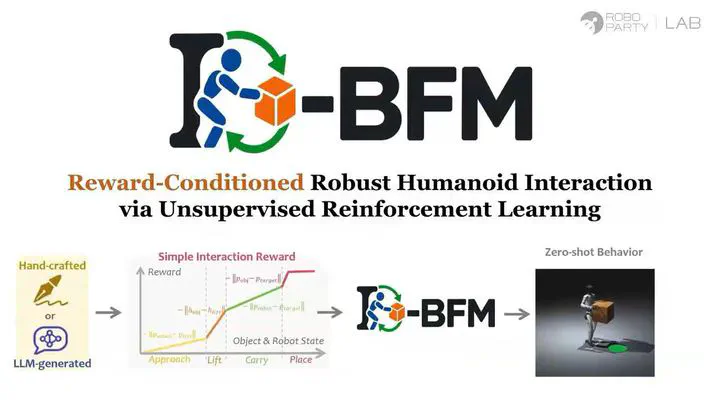 I-BFM project preview, from the authors’ project website (RoboParty Lab).
Equal contribution: Ziqi Han, Yitang Li and Junhan Sun.
One behavior space for interaction
I-BFM learns a shared representation of humanoid motion, object motion, and contact through unsupervised reinforcement learning. Downstream rewards are converted into latent commands, allowing one policy to perform different interaction tasks without optimizing a new task-specific policy.
Robust execution beyond nominal motion
Short-horizon interaction targets and longer-horizon goals support carrying, pushing, kicking, and task chaining. The work evaluates recovery after falls and external disturbances, alongside hardware loco-manipulation on a Unitree G1. The reported simulation Carry success is 94.3% under nominal conditions and 89.3% after robot falls in the evaluated benchmark.
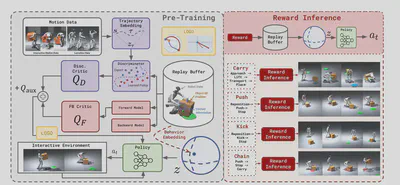
The overview separates representation pretraining from downstream reward inference. Project videos provide the corresponding simulation and real-robot demonstrations.