PegasusFlow: Parallel Rolling-Denoising Score Sampling for Robot Diffusion Planner Flow Matching
Jan 31, 2026· ,,,,,,,,,·
0 min read
,,,,,,,,,·
0 min read
Lei Ye
Haibo Gao
Peng Xu*
Zhelin Zhang
Junqi Shan
Ao Zhang
Wei Zhang
Ruyi Zhou
Zongquan Deng
Liang Ding
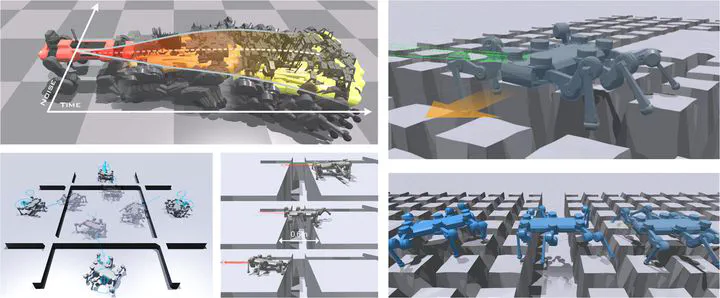 Image credit:
Abstract
Diffusion models offer powerful generative capabilities for robot trajectory planning, yet their practical deployment on robots is hindered by a critical bottleneck: reliance on imitation learning from expert demonstrations. This paradigm is problematic as it is often impractical to produce high quality data for specialized robots, and it creates an inefficient, theoretically suboptimal training pipeline. To overcome this, we introduce PegasusFlow, a parallel rolling-denoising framework that enables direct sampling of trajectory score gradients from environmental interaction, completely bypassing the need for expert data. Our core innovation is a sampling algorithm called Weighted Basis Function Optimization (WBFO), which leverages spline basis representations to achieve superior sample efficiency and faster convergence compared to traditional methods like MPPI. The framework is embedded within a scalable, asynchronous parallel simulation architecture that supports massively parallel rollouts for efficient data collection. Extensive experiments on trajectory optimization and robotic navigation tasks demonstrate that our approach, particularly Action-Value WBFO (AVWBFO) combined with a reinforcement learning warm-start, significantly outperforms baselines. In a challenging barrier-crossing task, our method achieved a 100% success rate and was 18% faster than the next-best method, validating its effectiveness for complex terrain locomotion planning.
Type
Publication
IEEE International Conference on Robotics and Automation (ICRA) 2026