Contact Planning for Multilegged Robots Under Constraints Through Parallel MCTS

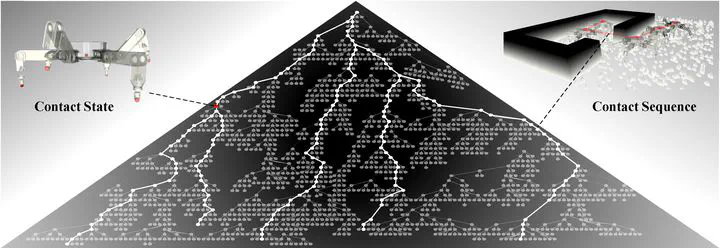 Research preview from the contact-planning project by Xu et al. (IEEE T-RO, 2025).
Choosing contacts under physical constraints
The planner jointly reasons about gait, footholds, and robot configuration. Reachability checks incorporate stability, collision avoidance, kinematics, joint torque limits, and contact constraints so that a promising contact sequence also admits physically feasible transitions.
Parallel Monte Carlo tree search
A hash-driven parallel MCTS framework shares search effort among workers. Valueless-node evaluation prunes trapped branches, depth-first backup supports longer-horizon decisions, and virtual loss balances parallel exploration. This combination targets useful solutions under a limited planning budget rather than exhaustive enumeration of contacts.
Evaluation across constrained scenes
The project studies sparse footholds and provides demonstrations on stairs, timber piles, tunnels, and discrete terrain, together with load and soft-terrain comparisons. Hexapod hardware experiments are complemented by humanoid simulation, testing how the contact-planning formulation transfers across robot structures.